
A geocoding API converts addresses into latitude and longitude coordinates through a programmable interface. You send a street address, zip code, or place name, and the API returns geographic coordinates you can plot on a map, run through a risk model, or store in a database.
Choosing the wrong geocoding API means paying for accuracy you don’t need or trusting coordinates that place a building on the wrong side of a river. The eight providers below range from free open-source options to enterprise platforms that process millions of addresses daily. This comparison covers pricing, accuracy, batch support, and the tradeoffs that actually matter when you’re building location-dependent workflows.
What Is a Geocoding API?
A geocoding API accepts an address string and returns structured location data: latitude, longitude, confidence score, and often the matched address components (street, city, state, country). Most providers also offer reverse geocoding, which takes coordinates and returns the nearest address.
The core differences between geocoding APIs come down to four factors:
- Data sources — proprietary datasets (Google, HERE, TomTom) vs. OpenStreetMap-derived (Nominatim, LocationIQ, OpenCage)
- Match quality — rooftop-level precision vs. street interpolation vs. centroid approximation
- Rate limits and batch support — single lookups vs. thousands of addresses per request
- Usage restrictions — some APIs require displaying results on their own maps
Feature Comparison Table
The table below compares all eight geocoding APIs across the dimensions that matter for production use. Coverage depth, batch capabilities, and data restrictions vary more than pricing alone would suggest.
| Provider | Data Source | Global Coverage | Batch Support | Reverse Geocoding | Display Restrictions | Best For |
|---|---|---|---|---|---|---|
| Google Maps | Proprietary | 200+ countries | No native batch | Yes | Must display on Google Maps | Consumer apps already using Google Maps |
| Mapbox | OSM + proprietary | 180+ countries | Yes (batch endpoint) | Yes | Must display on Mapbox maps | Developers building custom map UIs |
| HERE | Proprietary (former Nokia) | 200+ countries | Yes (batch API) | Yes | No restrictions | Logistics and fleet management |
| Geocodio | US Census + TIGER | US + Canada only | Yes (CSV upload) | Yes | No restrictions | US-focused analytics and CRA compliance |
| Radar | OSM + proprietary | Global | Yes | Yes | No restrictions | Mobile apps with geofencing needs |
| LocationIQ | OpenStreetMap | Global | Yes (bulk endpoint) | Yes | Attribution required | Budget-friendly production use |
| Nominatim | OpenStreetMap | Global | No | Yes | None (open source) | Self-hosted deployments, prototyping |
| Continuuiti | OSM + quality scoring | Global (30+ countries) | Yes (up to 5,000) | No | No restrictions | Risk teams needing geocoding + climate data |
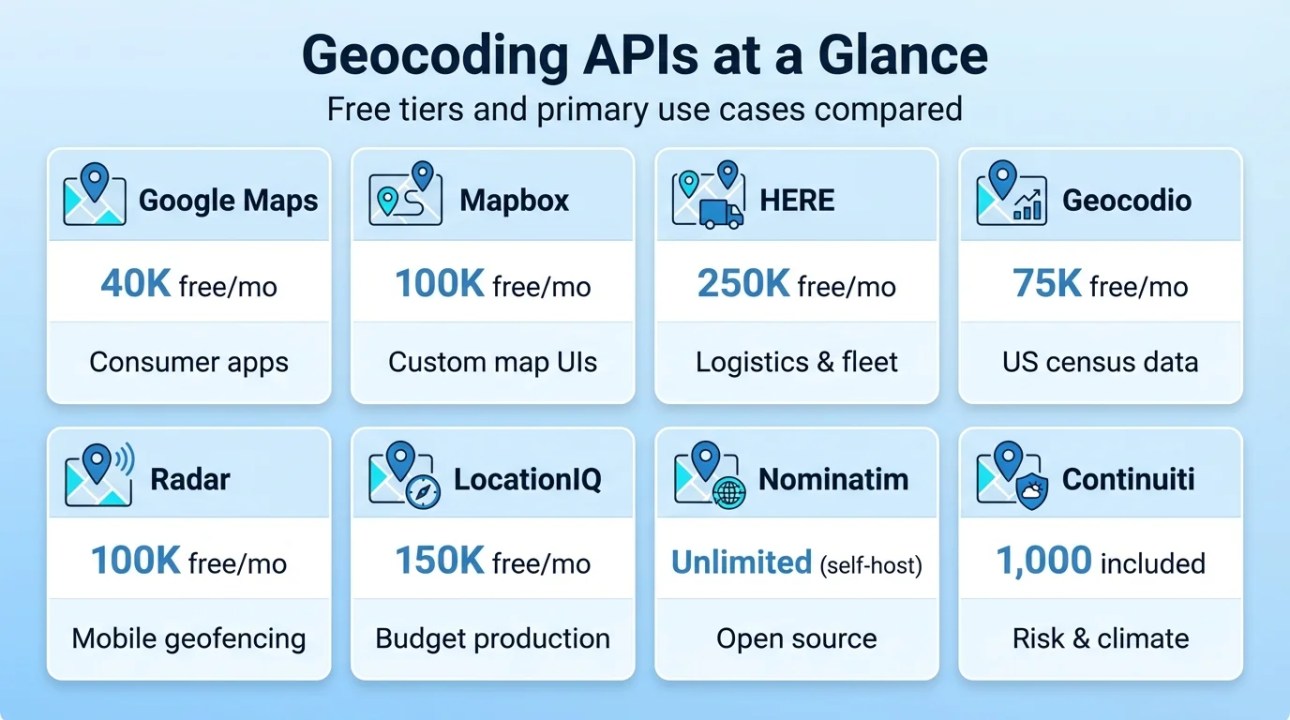
Geocoding API Profiles
Google Maps Geocoding API
Google’s geocoding API draws from the same address database that powers Google Maps, giving it the deepest coverage for residential addresses in most countries. The API handles ambiguous inputs well, often correcting misspellings and filling in missing components like zip codes.
The main limitation is cost. Google charges $5 per 1,000 requests after the $200 monthly free credit runs out, making it one of the most expensive options at scale. Google also requires that geocoded results be displayed on Google Maps, which rules out use cases where you need coordinates for internal processing without a map UI.
Response times are fast (50-100ms typical), and the API returns detailed address component breakdowns. For teams already embedded in the Google Cloud ecosystem, the API key management and billing integrations are straightforward.
Mapbox Geocoding API
Mapbox combines OpenStreetMap data with proprietary address datasets, giving it strong coverage in both developed and emerging markets. The geocoding API integrates tightly with Mapbox GL JS, making it the natural choice if you’re already using Mapbox for map rendering.
Pricing sits between Google and the budget options: $0.75 per 1,000 requests on the pay-as-you-go plan, with 100,000 free requests per month. Like Google, Mapbox requires that geocoded results be displayed using their mapping SDKs, which limits backend-only use cases.
Mapbox offers permanent geocoding (results you can store) and temporary geocoding (session-based, lower cost). The batch endpoint handles up to 1,000 addresses per request, which covers most mid-volume workflows.
HERE Geocoding API
HERE (formerly Nokia Maps) maintains one of the largest proprietary address databases, with particular strength in European and Asian markets. Their geocoding API returns confidence scores and match-level indicators that tell you whether a result is rooftop-accurate or interpolated from a street range.
HERE offers 250,000 free transactions per month, the most generous free tier among the proprietary providers. Paid pricing starts at $1 per 1,000 requests. Unlike Google and Mapbox, HERE does not require you to display results on their maps, making it a strong choice for backend processing.
The batch API handles large volumes and returns results asynchronously, which works well for processing address lists overnight. The API also includes address parsing and validation as separate endpoints.
Geocodio
Geocodio focuses exclusively on the United States and Canada, using US Census Bureau TIGER/Line data as its primary source. That narrow focus comes with a benefit: Geocodio returns census tract, congressional district, and school district data alongside coordinates, which no other geocoding API provides natively.
Banks and financial institutions use Geocodio for CRA (Community Reinvestment Act) compliance, where census tract lookups are required for every mortgage application. The CSV upload interface makes it accessible to analysts who don’t write code.
Pricing is aggressive: 2,500 free lookups per day, then $0.50 per 1,000 requests. The API is straightforward, with consistent response formats and no display restrictions. The tradeoff is clear: if you need addresses outside the US and Canada, Geocodio won’t help.
Radar
Radar started as a geofencing platform and expanded into geocoding. The API blends OpenStreetMap data with proprietary address sources and offers forward geocoding, reverse geocoding, IP geocoding, and autocomplete in a single SDK.
Pricing starts at $0.50 per 1,000 API calls for geocoding, with 100,000 free requests per month on the free plan. Radar doesn’t impose display restrictions, so you can use geocoded data in any application without showing a Radar-branded map.
The platform is designed for mobile-first applications, with native SDKs for iOS and Android that include background location tracking and trip detection. If your use case is a mobile app that needs geofencing alongside geocoding, Radar bundles both capabilities.
LocationIQ
LocationIQ wraps OpenStreetMap data in a commercial API with higher rate limits and SLA guarantees than you’d get from the public Nominatim instance. The free tier includes 5,000 requests per day, and paid plans start at $49 per month for 30,000 requests per day.
The API is Nominatim-compatible, which means existing code that calls Nominatim can switch to LocationIQ by changing the base URL. LocationIQ adds autocomplete, static maps, and a bulk geocoding endpoint on top of the base OSM data.
The main drawback is accuracy in areas where OpenStreetMap coverage is sparse. Rural addresses in developing countries may return centroid-level results (city center) rather than rooftop coordinates. For urban areas in North America, Europe, and East Asia, accuracy is competitive with proprietary providers.
Nominatim (OpenStreetMap)
Nominatim is the open-source geocoding engine behind OpenStreetMap. You can use the public instance at nominatim.openstreetmap.org for free, or self-host it on your own infrastructure for unlimited requests with no rate limits.
The public instance enforces a strict 1 request per second rate limit and prohibits bulk geocoding. Self-hosting removes those constraints but requires maintaining a PostgreSQL database with the full OSM planet file (currently around 70 GB compressed).
Nominatim’s accuracy depends entirely on how well the local OSM community has mapped an area. In Germany, Japan, and parts of the US, coverage rivals commercial providers. In others, you’ll get approximate results. The API returns a “place_rank” field that indicates match granularity, which helps filter low-confidence results programmatically.
Continuuiti Geocoding API
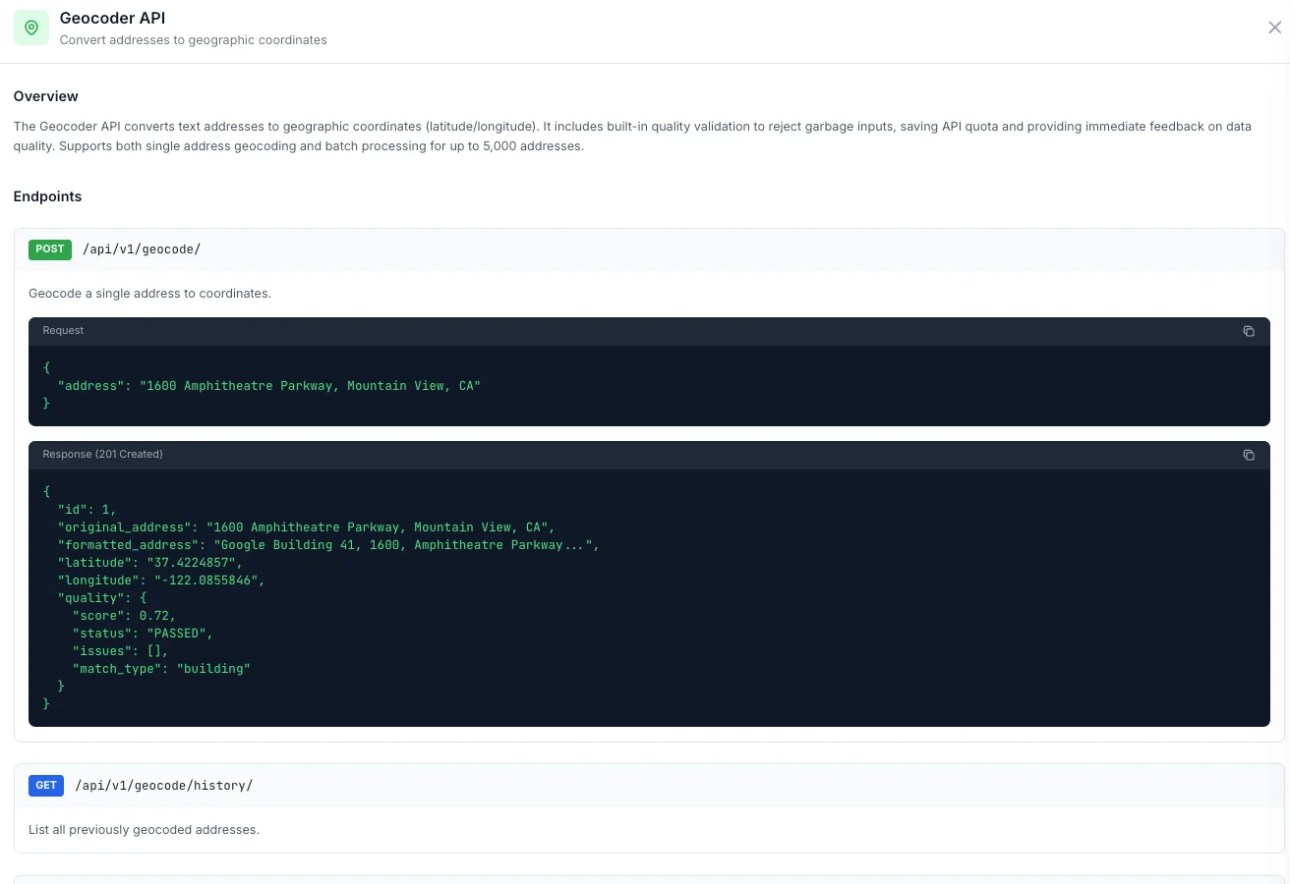
Continuuiti’s geocoding API is built for risk and compliance workflows where coordinates feed directly into climate risk models, land cover analysis, or regulatory reports. The API runs 5 quality checks on every address before geocoding: format validation, country detection, component parsing, duplicate detection, and confidence scoring.
The quality scoring system flags ambiguous results so downstream analysis doesn’t run on a city centroid when a rooftop coordinate was expected. Each result includes a quality grade (high, medium, low) and a breakdown of which checks passed or failed.
Batch processing handles up to 5,000 addresses per job. The geocoder sits within a broader platform that includes climate vulnerability assessment, land cover classification, and flood risk analysis, so geocoded coordinates can flow directly into a 12-hazard climate risk report without switching tools.
For implementation details, see the full Geocoder API documentation, including the quality envelope, garbage detection rules, batch endpoints, and code examples in cURL and Python.

Try the geocoder below. Enter any address or zip code and see the coordinates returned with a quality score:
Pricing Breakdown
Geocoding API pricing follows three models: pay-per-request, monthly subscriptions with request caps, and free open-source options with infrastructure costs. The table below shows the real cost at three volume levels.
| Provider | Free Tier | Cost per 1K Requests | 10K/month Cost | 100K/month Cost | 1M/month Cost |
|---|---|---|---|---|---|
| Google Maps | 40K/month ($200 credit) | $5.00 | Free | $300 | $4,800 |
| Mapbox | 100K/month | $0.75 | Free | Free | $675 |
| HERE | 250K/month | $1.00 | Free | Free | $750 |
| Geocodio | 2,500/day (~75K/month) | $0.50 | Free | $12.50 | $462.50 |
| Radar | 100K/month | $0.50 | Free | Free | $450 |
| LocationIQ | 5K/day (~150K/month) | ~$0.33 | Free | Free | $279 |
| Nominatim | Unlimited (self-hosted) | $0 (+ server cost) | $0* | $0* | $0* |
| Continuuiti | 1,000 addresses included | Contact sales | Free | Contact sales | Contact sales |
*Nominatim is free to use, but self-hosting requires a server with at least 64 GB of RAM and 1 TB of SSD storage. Cloud hosting costs for a self-hosted Nominatim instance run $200-500 per month depending on the provider and query volume.
Free vs. Paid Geocoding APIs
Free geocoding APIs fall into two categories: APIs with generous free tiers (HERE, Mapbox, Radar, LocationIQ) and truly free open-source tools (Nominatim). The distinction matters because free tiers come with rate limits and terms of service that can change, while open-source tools give you full control at the cost of infrastructure management.
Free tiers work well when:
- You process fewer than 100,000 addresses per month
- You need rooftop-level accuracy without managing your own servers
- Your application can handle rate limits (typically 5-50 requests per second)
Paid plans become necessary when:
- Volume exceeds free tier caps consistently
- You need an SLA with guaranteed uptime and response times
- Batch processing of tens of thousands of addresses is a regular workflow
- You require dedicated support for integration or troubleshooting
A common pattern is starting with a free tier for development and low-volume production, then switching to a paid plan or a different provider when volume scales. Watch for display restrictions that lock you into a specific mapping platform, as switching later means rewriting your frontend.
Geocoding Services vs. API-Based Solutions
Geocoding services is a broader category that includes desktop geocoding software, web-based CSV upload tools, and managed data processing platforms alongside traditional APIs. The right choice depends on who’s doing the geocoding and how the results are used.
| Approach | Users | Volume | Integration | Example |
|---|---|---|---|---|
| REST API | Developers | 1 to millions | Programmatic, any language | Google Maps, HERE, Continuuiti |
| CSV Upload | Analysts, ops teams | 100 to 100K | Manual upload/download | Geocodio, Continuuiti |
| Desktop Software (GIS) | GIS analysts | Variable | Esri, QGIS plugins | ArcGIS, QGIS + Nominatim |
| Self-Hosted Engine | DevOps, data teams | Unlimited | Full control, custom pipelines | Nominatim, Pelias |
APIs dominate when geocoding is part of an automated pipeline: a user submits an address, your backend geocodes it in real time, and the coordinates feed into the next step (mapping, risk scoring, routing). CSV upload tools work better for one-time batch geocoding jobs where an analyst needs to geocode a spreadsheet without writing code.
How to Choose a Geocoding API
Start with three questions:
1. Where are your addresses? If they’re all in the US, Geocodio gives you the best value with census data included. If they span multiple countries, you need a global provider like Google, HERE, Mapbox, or Continuuiti.
2. What happens after geocoding? If coordinates feed into a map UI, check display restrictions before committing. If they feed into analytics, risk models, or compliance reports, choose a provider without display requirements so you’re not paying for mapping you don’t use.
3. What accuracy level do you need? Rooftop precision matters for insurance, property risk, and last-mile delivery. Centroid-level accuracy (city or postal code center) is often sufficient for market analysis, regional reporting, and demographic studies. Our guide on how to geocode an address covers all four accuracy tiers and when each one matters.
For risk and compliance teams specifically, the geocoding step is rarely the end goal. Coordinates need to flow into flood risk models, climate vulnerability assessments, or regulatory filings. Choosing a geocoding API that connects directly to downstream analysis eliminates the data handoff between separate vendors.
Frequently Asked Questions
What is a geocoding API?
A geocoding API is a web service that converts street addresses, zip codes, or place names into geographic coordinates (latitude and longitude). You send an address as a text string via an HTTP request, and the API returns the corresponding coordinates along with metadata like confidence scores and matched address components.
Is the geocoding API free?
Several geocoding APIs offer free tiers. HERE provides 250,000 free requests per month, Mapbox and Radar offer 100,000, and LocationIQ provides 5,000 per day. Nominatim is fully free and open source but has a 1 request/second rate limit on the public instance. For unlimited free geocoding, you can self-host Nominatim on your own server.
What is the best geocoding API?
The best geocoding API depends on your use case. Google Maps offers the deepest address coverage globally. HERE provides the most generous free tier at 250,000 requests per month. Geocodio is strongest for US addresses with census tract data. Nominatim is the best free and open-source option. For risk and compliance workflows, Continuuiti combines geocoding with quality scoring and climate risk analysis in one platform.
How much does geocoding cost?
Geocoding API costs range from free to $5 per 1,000 requests. Google Maps is the most expensive at $5 per 1,000. Geocodio and Radar charge $0.50 per 1,000. LocationIQ costs approximately $0.33 per 1,000. Self-hosted Nominatim has no per-request cost but requires server infrastructure ($200-500 per month for cloud hosting).
How do I set up a geocoding API?
Most geocoding APIs follow the same setup pattern: create an account, generate an API key, and make HTTP requests to the provider’s endpoint with your address as a query parameter. The response returns JSON with latitude, longitude, and match metadata. Most providers offer SDKs for Python, JavaScript, and other languages that simplify integration.
What is the difference between geocoding and reverse geocoding?
Geocoding converts an address into coordinates (latitude and longitude). Reverse geocoding does the opposite: it takes coordinates and returns the nearest street address. Most geocoding APIs offer both directions. Geocoding is used when you have addresses and need map coordinates. Reverse geocoding is used when you have GPS coordinates from a device and need a human-readable address.
