
- ESRS E1-2 (Nov 2025 amended) and IRO-1 paragraph 20 (2023 binding) require disclosure of the physical-risk methodology, not scenario outputs.
- Scenario analysis under ESRS is voluntary (EFRAG paragraph 285), a deliberate divergence from IFRS S2 which makes scenarios mandatory.
- The ESRS hazard universe is 28 distinct hazards from EU Taxonomy AR 11: 15 chronic and 13 acute across four physical-process categories (temperature, wind, water, solid mass).
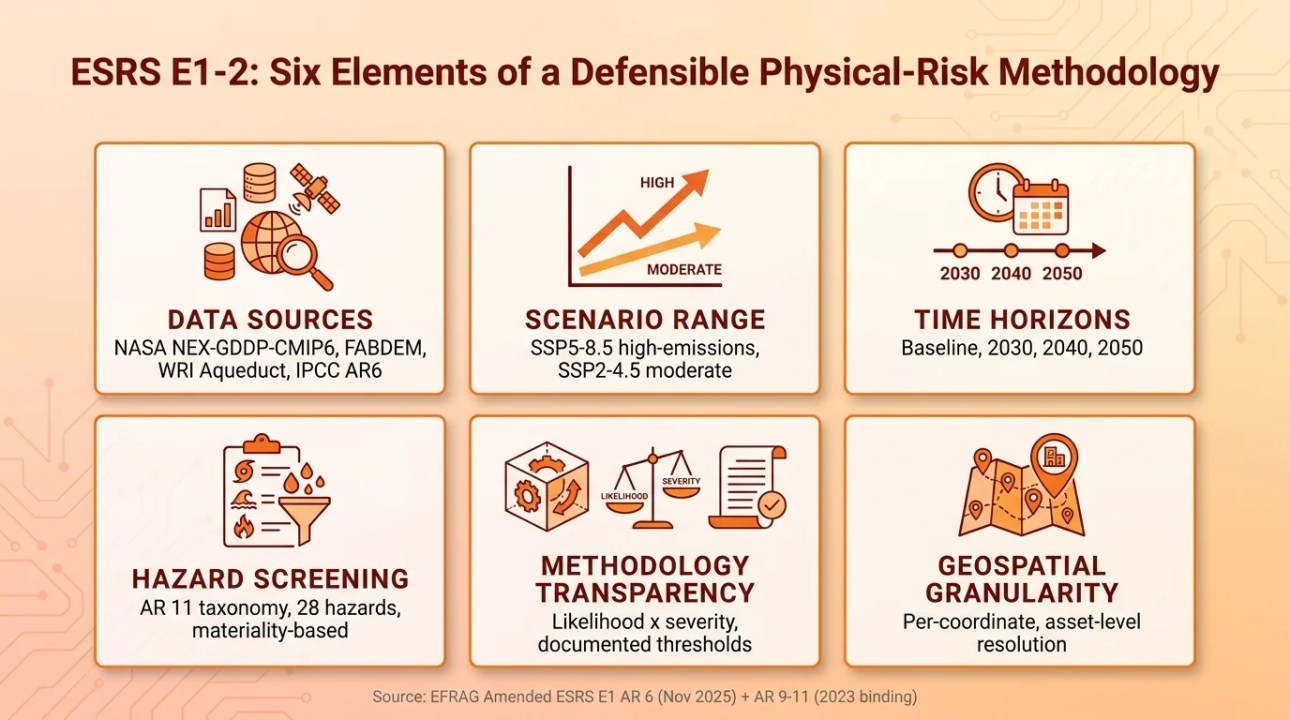
- Six methodology elements satisfy “key elements” disclosure: data sources, scenario range, time horizons, hazard screening, methodology transparency, geospatial granularity.
Why this matters now
Wave 1 reporters (the roughly 500 large public-interest entities already subject to the Non-Financial Reporting Directive, or NFRD) are filing their first sustainability statements under the Corporate Sustainability Reporting Directive (CSRD) in 2025, covering FY 2024. The physical-risk identification methodology disclosure is binding from year one. It is also one of the two places auditors and supervisors look first when assessing whether the sustainability statement is defensible (the other being the anticipated financial effects disclosure under DR E1-9). In the November 2025 amended draft published by EFRAG (the European Financial Reporting Advisory Group, the technical advisor that drafts the ESRS), this material has been promoted into a standalone Disclosure Requirement (DR E1-2), with expanded methodology expectations and explicit scenario-analysis paragraphs. This piece walks the requirement paragraph by paragraph, anchored on the physical-risk limb, and grounds the “key elements of methodology” expectation against the asset-level data and scenarios that actually satisfy it.
A note on transition risk
DR E1-2 (in both the 2023 binding text and the November 2025 amended draft) covers physical risks and transition risks together. This piece walks only the physical-risk limb of the requirement. Transition-risk identification (carbon pricing exposure, policy and legal risk, technology substitution, market shifts) is out of scope of this piece, and will be covered separately. Where a paragraph in the standard names both physical and transition risks, the piece quotes the full text but reads it only against the physical-risk lens.
What changed: the structural pivot from binding to amended
In the 2023 binding standard (Commission Delegated Regulation 2023/2772 Annex 1, ESRS E1), the code “DR E1-2” is not the risk-identification disclosure. It is Policies related to climate change mitigation and adaptation. The risk-identification methodology lives in three places, in two cross-cutting Disclosure Requirements that ESRS E1 topically specifies:
- ESRS 2 IRO-1 (Impacts, Risks, Opportunities, paragraph 1: the process to identify and assess material climate-related impacts, risks and opportunities) at paragraphs 20–21
- ESRS 2 SBM-3 (Strategy, Business Model, paragraph 3: material impacts, risks and opportunities and their interaction with strategy and business model) at paragraphs 18–19
- Application Requirements 9–15 of ESRS E1, which give per-paragraph implementation guidance for the IRO-1 and SBM-3 disclosures (including the AR 11 hazard taxonomy and AR 13–15 scenario-analysis paragraphs)
Paragraphs 20 and 21 of the binding ESRS E1 are the topical specification of ESRS 2 IRO-1 within climate. They apply the cross-cutting IRO-1 framework specifically to climate-related impacts, risks, and opportunities. They do not stand alone outside the ESRS 2 framework.
The November 2025 amended draft restructures this material. Risk identification and scenario analysis are promoted into a new standalone DR E1-2 (paragraphs 13–16). Resilience analysis is promoted into a new standalone DR E1-3 (paragraphs 17–18). EFRAG Basis for Conclusions paragraph 322 explains the decision verbatim:
“Many stakeholders asked for less redundancy between ESRS 2 and the topical standards in their feedback for the public call. Likewise, most respondents asked for a clarification on the relationship between E1-2 and E1-3. Consequently, it has been decided to rename former IRO-1 by E1-2 and former SBM-3 by E1-3 to highlight that they are additions specific to the E1 topics.”
In plain terms: the substance hasn’t changed much; the codes have. The same paragraph code now points to different content depending on which version of the standard you’re reading. Until the European Commission adopts the amended ESRS, the 2023 binding text is the operative law for Wave 1 filers. This piece walks the amended structure paragraph by paragraph and then maps each paragraph back to its binding equivalent in the closing section.
DR E1-2 in the amended draft: paragraph by paragraph
The November 2025 amended draft sets out DR E1-2 in four paragraphs (13 to 16) plus one application requirement (AR 6 for paragraph 15). Each paragraph below is quoted verbatim from the EFRAG amended draft, followed by a plain-language interpretation.
Para 13: Objective
“The objective of this DR is to enable an understanding of how the undertaking identifies and assesses climate-related risks and opportunities for financial materiality.”
In plain terms: the objective is to enable readers of the sustainability statement to understand how the undertaking goes about finding and sizing its climate risks. The framing is “for financial materiality,” which means this DR focuses on risks that could affect the undertaking’s own financial position and prospects. (Impact materiality (which asks how the undertaking affects climate change rather than how climate change affects the undertaking) is covered through ESRS double materiality elsewhere in the standard.)
Para 14: Risk classification
“The undertaking shall explain for each material climate-related risk identified (per ESRS 2 IRO-2, paragraph 37) whether it classifies the risk as a climate-related physical risk or a climate-related transition risk.”
In plain terms: for every climate-related risk the undertaking has identified as material through its IRO-2 (Impacts, Risks, Opportunities paragraph 2: disclosure of material IROs) process, it must say whether the risk is a physical risk (a direct exposure to climate hazards like flooding or heat) or a transition risk (policy, market, technology, or reputational risk arising from the shift to a lower-carbon economy). This classification matters because the assessment methodology, the scenario inputs, and the audit defensibility tests differ between the two classes. This piece covers only the physical-risk classification.
Para 15: Methodology disclosure (the central requirement)
“In addition to the disclosure provided in accordance with ESRS 2 IRO-1, the undertaking shall disclose key elements of the methodology used to assess how its assets and business activities in own operations and its upstream and downstream value chain may be exposed and be sensitive over the short, medium and long term to:
(a) climate-related hazards; and
(b) climate-related transition events and trends.”
In plain terms: the undertaking must disclose the key elements of its methodology for assessing climate-related exposure and sensitivity. The disclosure covers own operations and the upstream and downstream value chain. The time-horizon framing (short, medium, long term) reflects the broader ESRS 1 (General Requirements) requirement that all material sustainability disclosures be reported across three time horizons.
This is the central requirement of the entire DR. EFRAG Basis for Conclusions paragraph 285 (quoted in full in the next section) makes clear that scenario analysis itself is not required by the standard, but the methodology disclosure is. Read this paragraph carefully: “key elements of the methodology” includes (for physical risk) data sources, hazard screening procedure, likelihood and severity scoring, time-horizon definitions, geographic granularity, and the scope of operations covered. The next section on what this looks like in practice grounds this against documented per-location hazard data.
Para 16: Scenario analysis (conditional)
“If climate-related scenario analysis is used, the undertaking shall disclose: (a) the ranges of scenarios applied, including (i) whether for physical climate risks at least one high-emission scenario was used, and (ii) whether for climate transition risks at least one scenario in line with limiting global warming to 1.5°C with no or limited overshooting was used, and (iii) the associated global average temperature projection of the scenarios and why they are considered relevant; (b) the scope of operations used (e.g. operating locations, business units); (c) the key assumptions made (e.g. policies, macroeconomic trends, national or regional variables, energy use and mix, technology developments); (d) the time period when it was carried out.”
In plain terms: scenario analysis is conditional under ESRS, not mandatory. The opening clause “If climate-related scenario analysis is used” governs the entire paragraph. If the undertaking does use scenario analysis, it must disclose the scenarios applied (with at least one high-emission scenario for physical risk and at least one 1.5°C scenario for transition risk), the scope of operations covered, the key assumptions, and the time period of the analysis. The “if used” framing is the deliberate ESRS deviation from IFRS S2, which makes scenario analysis mandatory. The next section walks the EFRAG drafter intent on this divergence.
AR 6 for paragraph 15
The amended draft’s Application Requirement for paragraph 15 (the methodology disclosure) describes how the methodology should screen hazards across time horizons and assess exposure and sensitivity. The rendered text in the EFRAG draft has the methodology disclosure split across the AR section; for the cleaner reading, refer to the EFRAG amended ESRS E1 exposure draft (November 2025), page 6. The substantive content: methodology must screen the undertaking’s assets and business activities for exposure to identified climate-related hazards over the short, medium, and long term, considering likelihood, magnitude, and duration, as well as the locations of assets and value-chain dependencies.
Sample Climate Risk Assessment
See a full climate risk assessment, end to end
We’ll email you a complete worked example for a manufacturing site: 12 hazards, multiple scenarios, and value-at-risk out to 2050. It’s the underlying assessment that feeds an ESRS E1-9 physical-risk disclosure.
The hazard taxonomy: 28 hazards, not 8
ESRS E1 reproduces the four-by-two hazard matrix from Annex II of the EU Taxonomy Climate Delegated Act (Commission Delegated Regulation 2021/2139) at AR 11 of the 2023 binding standard. The full taxonomy enumerates 28 distinct hazards (15 chronic, 13 acute) across four physical-process categories: temperature-related, wind-related, water-related, and solid-mass-related. The hazard table is reproduced in the ESRS E1 11-disclosure-requirements walkthrough on Continuuiti’s blog. There is no “eight hazards” subset in the standard; the rule for scope decisions is materiality, with the rationale documented.
EFRAG’s November 2025 amended draft removes the explicit AR 11 hazard table from the standard text per Basis for Conclusions paragraph 288, on the basis that the requirement to screen hazards persists but the taxonomy may move into separate implementation guidance. Until that guidance lands, the AR 11 taxonomy from the 2023 binding standard remains the de facto reference list.
Scenario analysis is voluntary under ESRS
This is the central clarification in the amended draft. EFRAG Basis for Conclusions paragraph 285 records the drafter intent:
“Some of the stakeholder feedback addressed indicated the need to clarify whether the use of scenario analysis was required to identify risks. The provisions were revised to emphasise an expectation that undertakings report on key elements of the methodology to assess climate risks, while at the same time clarifying that the scenario analysis is not required by ESRS. The decision to not make scenario analysis mandatory is a deliberate deviation from IFRS S2, which requires it. … Accordingly, the provisions related to scenario-analysis rely on conditional wording such as ‘if’ and ‘whether’. Moreover, methodological requirements on the identification of IROs and use of scenario analysis have been consolidated in a single datapoint, improving clarity (E1, paragraph 16). The wording as also been more closely aligned with IFRS S2.”
In plain terms: ESRS E1 does not require the undertaking to run climate-related scenario analysis. What it requires is that the undertaking disclose the key elements of the methodology it uses to identify and assess physical risks. If scenario analysis is part of that methodology, the undertaking has to disclose specifics (paragraph 16). If scenario analysis is not part of that methodology, the undertaking still has to disclose the key elements of whatever methodology it does use.
This divergence from IFRS S2 (which mandates scenario analysis under paragraph 22 of IFRS S2) is deliberate. For an EU reporter that also files under IFRS S2 (for example, a dual-listed European parent), the IFRS S2 obligation is binding even though the ESRS provision is permissive. For an EU-only reporter, the lighter ESRS standard governs.
The audit defensibility implication is significant. Under ESRS, the test is whether the methodology is documented and reproducible. An auditor or supervisor should be able to re-run the assessment with the same inputs and reach the same conclusion. Running scenarios without methodology documentation does not satisfy the requirement. Running a defensible methodology without scenarios does. The burden of defence is on the methodology disclosure, not on the scenario outputs.
EFRAG Basis for Conclusions paragraph 287 adds one carve-out: “a methodological provision was added which clarifies that financial institution may leverage on applicable prudential frameworks.” Banks, insurers, and other regulated financial institutions can therefore reference their existing supervisory frameworks (European Central Bank climate stress tests, European Insurance and Occupational Pensions Authority insurance-sector scenarios, European Banking Authority prudential climate analyses) as the methodology base, rather than building a parallel ESRS-specific methodology from scratch.
This optional-scenario stance is one of the clearest contrasts with the older TCFD framework. See ESRS E1 vs TCFD for the full physical-risk comparison.
What “key elements of methodology” looks like in practice
The standard does not prescribe a specific methodology. What it prescribes is methodology disclosure sufficient for an audit-defensible reading. A documented per-location physical-risk methodology typically covers six elements.
Data sources. Named, versioned datasets with provenance and resolution. For atmospheric climate variables, NASA NEX-GDDP-CMIP6 is the standard reference dataset for downscaled climate projections (approximately 25-kilometre resolution, bias-corrected, covering 1950 to 2100). For elevation in flood and sea-level-rise contexts, FABDEM (Hawker et al., 2022) is the bare-earth digital terrain model at 30-metre resolution, which corrects the urban-area elevation bias present in older datasets like SRTM. For land cover, ESA WorldCover provides 10-metre resolution. For water stress, the WRI Aqueduct 4.0 framework provides basin-level indicators. For flood depth, JRC GloFAS and WRI Aqueduct V2 provide riverine and coastal flood projections. For sea level rise specifically, IPCC AR6 projections cover all SSP (Shared Socioeconomic Pathway) scenarios including SSP1-2.6 (which is absent from the NEX-GDDP-CMIP6 collection).
Scenario range. ESRS E1 AR 11(d) of the 2023 binding standard frames the scenario requirement as “high emissions climate scenarios, which may, for example, be based on IPCC SSP5-8.5, relevant regional climate projections based on these emission scenarios, or NGFS (Network for Greening the Financial System) climate scenarios with high physical risk such as ‘Hot house world’ or ‘Too little, too late’.” The requirement is for a high-emissions scenario; SSP5-8.5 is named as an example, not as a mandate. In practice, SSP5-8.5 (high fossil-fuel pathway, approximately 4.4°C warming by 2100) paired with SSP2-4.5 (middle-of-the-road, approximately 2.7°C by 2100) provides the regulator-aligned range across high and moderate trajectories.
Time horizons. Short term (current reporting period), medium term (typically 2030), and long term (typically 2040 and 2050, sometimes 2100). The time horizons should align with the strategic planning and capital-allocation horizons of the undertaking, per AR 11(b) of the binding standard.
Hazard screening. The methodology must cover the hazard categories material to the undertaking. Where a platform screens the asset across a defined set of hazards (for example, twelve hazards covering heat, drought, wildfire, river and coastal flooding, sea level rise, severe storm, water stress, precipitation and temperature change, landslide, and subsidence), that set should be enumerated and traced back to the AR 11 categories. Hazards excluded from screening should be justified (typically by materiality assessment).
Methodology transparency. The likelihood-and-severity scoring approach, the per-hazard thresholds, any composite scoring, and the geographic modifiers applied. AR 11(c) of the binding standard requires the methodology to take into consideration “likelihood, magnitude and duration of the hazards as well as the geospatial coordinates … specific to the undertaking’s locations and supply chains.” A 5-point composite score with documented per-hazard thresholds satisfies this disclosure requirement.
Geospatial granularity. Per-location assessment at coordinate-level resolution is the highest defensibility standard. Site-level or facility-level granularity meets the AR 11(c) requirement that the methodology consider geospatial coordinates specific to the undertaking’s locations and supply chains (the binding text names the EU Nomenclature of Territorial Units of Statistics, or NUTS, as one example reference system). Regional or national average data does not meet this requirement, except as a stated proxy for value-chain segments where coordinate data is not available.
The Continuuiti physical risk platform is engineered around these six methodology elements: documented per-coordinate hazard assessment across twelve hazards, named datasets, baseline plus 2030 / 2040 / 2050 horizons, and dual SSP2-4.5 / SSP5-8.5 scenarios. The methodology wiki at continuuiti.com/methodology/climate-risk/ is the buyer-facing version. For ESRS E1 reporters, the methodology disclosure in the sustainability statement can reference Continuuiti’s documented approach by name as the underlying methodology, alongside the reporter’s own materiality assessment.
Free Climate Risk Report
Run a free climate risk assessment for your location
12 hazards across multiple emission scenarios and four time horizons, for any site. Start free, no call required.
Reading the binding text: where the methodology lives for Wave 1 filers now
For a Wave 1 reporter filing FY 2024 sustainability statements in 2025 under the binding ESRS E1, the operative paragraphs are not the amended draft’s DR E1-2 but the binding text’s IRO-1 + SBM-3 + AR layout. The mapping is:
| Amended draft (Nov 2025) | Binding standard (Del Reg 2023/2772) |
|---|---|
| Para 13 (objective) | Implicit in ESRS 2 IRO-1 and SBM-3 |
| Para 14 (physical-vs-transition classification) | Para 18 of ESRS E1 (SBM-3 topical specification) |
| Para 15 (methodology disclosure for hazard and transition exposure) | Para 20 of ESRS E1 (IRO-1 topical specification), specifically 20(b) for physical |
| Para 16 (scenario-analysis specifics, conditional) | Para 21 of ESRS E1 (IRO-1 topical specification) and AR 13 to AR 15 |
| AR 6 (methodology over time horizons) | AR 9 to AR 11 of ESRS E1 |
| Hazard taxonomy (deleted from amended; expected to move to guidance) | AR 11 table (binding) |
The substance is similar across the two versions; the structural rearrangement is what matters for citation hygiene in the sustainability statement. A Wave 1 reporter citing the methodology disclosure should reference IRO-1 paragraph 20 and SBM-3 paragraph 18, with the AR 11 hazard table as the screening reference.
One clarifying point on the Wave 1 Quick Fix (Commission Delegated Act C(2025) 4812 final, adopted 11 July 2025). The Quick Fix annex defers two anticipated-financial-effects disclosures for Wave 1 reporters in FY 2025–2026: ESRS 2 SBM-3 paragraph 48(e) (the anticipated-financial-effects portion of SBM-3) and ESRS E1-9 (the central financial-effects disclosure). It does not defer IRO-1 paragraphs 20 and 21 (the risk-identification process) or SBM-3 paragraphs 18 and 19 (physical-vs-transition classification and resilience analysis). The methodology disclosure walked in this piece is binding for all Wave 1 filers from FY 2024.
How this fits with E1-3 (resilience) and E1-9 / E1-11 (financial effects)
DR E1-2 is the methodology layer of a three-disclosure stack on physical climate risk. The other two layers are covered in subsequent Continuuiti pieces on the ESRS E1 cluster.
DR E1-3 (Resilience in relation to climate change), which is a standalone DR in the amended draft and paragraph 19 of SBM-3 in the binding standard, takes the risks identified under E1-2 and asks the undertaking how strategy and business model respond to them, and how resilient the undertaking is over each time horizon. Identification feeds resilience.
DR E1-9 (in the 2023 binding standard, Anticipated financial effects from material physical and transition risks and potential climate-related opportunities) and its successor DR E1-11 in the November 2025 amended draft turn the risks identified and assessed under E1-2 into monetary figures. For physical risk: the carrying amount of materially exposed assets before adaptation, the percentage covered by adaptation actions, and net revenue from activities exposed to physical risks (the European parallel to IFRS S2 paragraph 29(c)). Identification and resilience feed quantification.
The three layers are intended to be read together. A defensible E1-9 / E1-11 quantification rests on a defensible E1-2 methodology. For how that quantification works in practice, see our walk of the ESRS E1-9 and E1-11 financial-effects disclosure. A reporter whose E1-2 methodology disclosure is weak will be unable to support an E1-9 / E1-11 quantification at audit.
Frequently asked questions
Is scenario analysis required under ESRS E1?
No. EFRAG Basis for Conclusions paragraph 285 records the drafter intent that scenario analysis is not mandatory under ESRS, a deliberate divergence from IFRS S2 paragraph 22 which does require it. Paragraph 16 of the amended DR E1-2 uses conditional ‘if used’ wording. What ESRS does require is disclosure of the key elements of the methodology used to identify and assess climate-related risks, with or without scenarios.
What is the difference between the 2023 binding ESRS E1 and the November 2025 amended draft for E1-2?
In the 2023 binding standard, the risk-identification methodology lives in ESRS 2 IRO-1 paragraphs 20-21, SBM-3 paragraphs 18-19, and Application Requirements 9-15 of ESRS E1. The November 2025 amended draft consolidates this material into a new standalone DR E1-2 (paragraphs 13-16) plus AR 6, with resilience analysis split into a separate DR E1-3. Until the European Commission adopts the amended ESRS, the 2023 binding text remains the operative law for Wave 1 filers.
Does the Wave 1 Quick Fix defer ESRS E1-2?
No. Commission Delegated Act C(2025) 4812 final (the Wave 1 Quick Fix, adopted 11 July 2025) defers two anticipated-financial-effects disclosures for Wave 1 reporters in FY 2025-2026: ESRS 2 SBM-3 paragraph 48(e) and ESRS E1-9. It does not defer IRO-1 paragraphs 20 and 21 (the risk-identification process) or SBM-3 paragraphs 18 and 19 (physical-vs-transition classification). The methodology disclosure is binding for all Wave 1 filers from FY 2024.
How does ESRS E1-2 compare to IFRS S2 paragraph 22?
Both standards require disclosure of the methodology used to identify and assess climate-related risks. IFRS S2 paragraph 22 mandates scenario analysis as the methodology vehicle for resilience assessment. ESRS E1-2 (amended) and IRO-1 paragraph 21 (binding) treat scenario analysis as conditional, required only if used. For dual-listed European parents, the IFRS S2 obligation governs even though ESRS is permissive. For EU-only reporters, the lighter ESRS standard applies.
What does ‘key elements of methodology’ actually require a reporter to disclose?
Application Requirement 6 of the amended draft and AR 9-11 of the 2023 binding standard expand ‘key elements’ into six components: (1) named, versioned data sources with provenance and resolution, (2) the scenario range used (the standard names IPCC SSP5-8.5 as an example high-emission scenario), (3) short / medium / long-term time horizons aligned with strategic planning, (4) the hazards screened with explicit reference to the AR 11 taxonomy and justification for any exclusions, (5) the likelihood-and-severity scoring approach with documented thresholds, and (6) per-location geospatial granularity at coordinate level.
Sources
-
Commission Delegated Regulation (EU) 2023/2772 of 31 July 2023, supplementing Directive 2013/34/EU as regards sustainability reporting standards. Annex I (ESRS E1 Climate Change). The binding text of ESRS E1, in force for Wave 1 reporters from financial years beginning on or after 1 January 2024. Available at EUR-Lex CELEX:32023R2772. Paragraphs referenced in this piece: 18, 19, 20, 21; AR 11, AR 13, AR 15.
-
EFRAG November 2025 amended draft ESRS E1 Climate Change. EFRAG exposure draft, not yet adopted by the European Commission, targeted for financial-year 2027 effect under the broader Omnibus simplification timeline. Published by EFRAG as part of the sustainability reporting consultation on amended ESRS standards. Paragraphs referenced in this piece: 13, 14, 15, 16; DR E1-2 + AR 6.
-
EFRAG Basis for Conclusions on the amended ESRS, December 2025. The drafter-intent layer for the November 2025 amended draft. Key paragraphs cited: 284 (rename rationale), 285 (scenario-analysis-voluntary rationale), 287 (financial-institution prudential carve-out), 288 (hazard-examples deletion), 322 (rename confirmation).
-
Commission Delegated Regulation (EU) 2021/2139 of 4 June 2021 (the EU Taxonomy Climate Delegated Act). Annex II is the upstream source of the climate-related hazard taxonomy that ESRS E1 AR 11 reproduces.
-
Commission Delegated Act C(2025) 4812 final of 11 July 2025 (the “Wave 1 Quick Fix”). Amends Appendix C of ESRS 1 to provide additional phase-in relief for Wave 1 reporters in FY 2025–2026.
-
IFRS S2 Climate-related Disclosures, paragraph 22 (scenario analysis) and paragraph 29(c) (anticipated financial effects). For the IFRS S2 paragraph-by-paragraph treatment of physical-risk identification and quantification, see the companion pieces on continuuiti.com/blog/ifrs-s2-paragraph-22-scenario-analysis/ and /blog/ifrs-s2-paragraph-29c-physical-risk/.
-
Continuuiti Methodology Wiki at continuuiti.com/methodology/climate-risk/. The buyer-facing documentation of named datasets (NASA NEX-GDDP-CMIP6, FABDEM, ESA WorldCover, IPCC AR6 SLR, WRI Aqueduct, JRC GloFAS), scenario range (SSP2-4.5 and SSP5-8.5), time horizons (baseline, 2030, 2040, 2050), and per-coordinate hazard assessment across twelve hazards.
